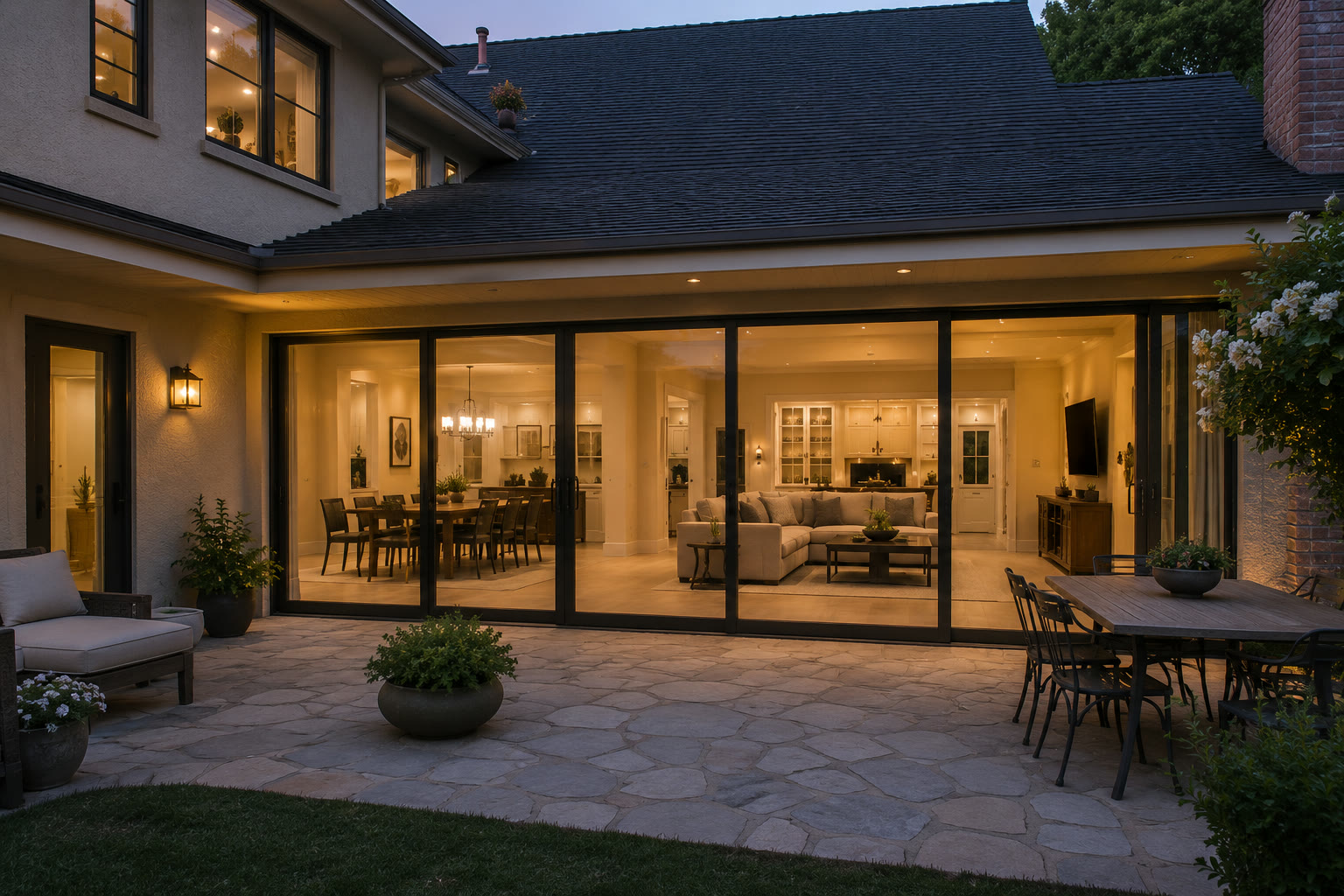
What "pocket" means on a sliding glass door
On an ordinary sliding glass door, the moving panel or panels come to rest stacked behind a fixed pane when you open them — you can still see a stripe of framed glass sitting in the opening. A pocket configuration takes the panel one step further: it slides past the edge of the opening and into a cavity built into the wall next to it, so at full open there is nothing in the opening at all. The interior and exterior spaces read as one continuous gap, with a track underfoot and no panel in view anywhere.
It is the same idea as an interior pocket door disappearing into a stud wall, applied to an exterior sliding glass system. Our COR Vision system offers it as an option alongside its standard single, double and triple track configurations — the same ¾-inch meeting-stile system, run into a wall pocket instead of stacking in the opening.
It is construction, not an accessory
The part that actually holds the panel out of sight is not part of the door system at all — it is a stud-wall cavity, framed and finished by the building side of the project, sized to the panel it needs to receive. That cavity has to be planned alongside the door, not added afterward. Once a wall is framed, insulated, wired and drywalled with no cavity left for a panel, adding one means opening that wall back up, not bolting something onto it.
This is the detail that most changes the scope of the job compared with a wall-mounted slider. A standard opening is a door system going into a rough opening someone else framed. A pocket opening is a door system and a piece of wall construction that have to be coordinated together, usually with the general contractor or framer, before either one is finished.
New construction versus a retrofit
In new construction, framing a pocket wall alongside the door opening is a straightforward sequencing decision — it just has to happen at the framing stage, with the door supplier's dimensions in hand before the wall closes up.
In a retrofit, it depends entirely on what is already inside the wall you want the panel to disappear into. If that wall carries plumbing, wiring, ductwork or structural framing that cannot move, a pocket is not automatically off the table, but it stops being a simple decision and starts being one that needs the wall opened up and inspected first. We will tell you plainly if that is what your project needs before proposing a pocket configuration — guessing at what is inside a finished wall is exactly the kind of thing this house does not do.
What you give up for a fully hidden panel
- Access for service. The rollers and track sit inside a finished wall cavity, so a pocket design needs a removable access panel built in from the start — retrofitting access after the fact means cutting into finished wall.
- The wall itself is spoken for. Once a stud bay is a door pocket, it is not available for anything else — no outlet, no future plumbing run, no shelving anchored into it.
- More detailing at the pocket end. Water management and air sealing where a track disappears into a wall are a more involved detail than a track that simply stops at a jamb, and they have to be gotten right the first time.
Why pocket sliding doors aren't the default choice
Every major exterior door manufacturer we compete against — including the aluminum and vinyl systems from the big national brands — offers a pocket option, so it is not an obscure or unusual product. What keeps it from being the default is the added construction dependency above, not anything wrong with the idea. Most openings do not need a panel to vanish entirely; they need a slim, uninterrupted view, and a wall-mounted slider already gives you that at a ¾-inch central junction with the panel stacked and out of the way. A pocket buys you the same open view with the panel out of sight too, at the cost of turning part of the wall into a component of the door.
Where the extra scope is worth it
A pocket configuration earns its keep when the opening is meant to erase the line between two spaces entirely — an interior room and a covered outdoor room that are really meant to function as one space when the door is open, where even a stacked panel in the doorway reads as a visible seam. It is a design decision about how the opening should look and work at full open, not a default upgrade to add to every sliding door because it can be done.
It is worth noting there is a separate, unrelated product category that also gets called a "glass pocket door": decorative interior pocket doors with a glass insert, used as room dividers rather than exterior doors. Those are wood or steel-framed, sized for interior openings, and sold by specialty interior-door suppliers. They are a different product built for a different job — nothing here about wall-pocket construction or panel weight applies to them, and we do not fabricate or install that category.
Getting a real answer for your opening
Whether a pocket configuration is realistic for a specific opening comes down to what is in the adjacent wall and how the project is sequenced, and that is a survey question, not a spec-sheet one. We look at the opening, the wall next to it, and where the project stands — framing not yet closed up, or an existing finished wall — before proposing a pocket option over a standard sliding glass door configuration. If width is also a factor in the decision, our guide to how wide a sliding glass door can be covers what actually limits a run before you get to the pocket question at all.